
Which Countries Have the Highest Life Expectancy? What the Latest UN Data Shows


Last Updated on September 10, 2026
Global data note: This article uses the United Nations World Population Prospects 2024 revision, which remains the latest full UN population dataset. Its 2025 figures are projections, not a census of how long people who died in 2025 actually lived.
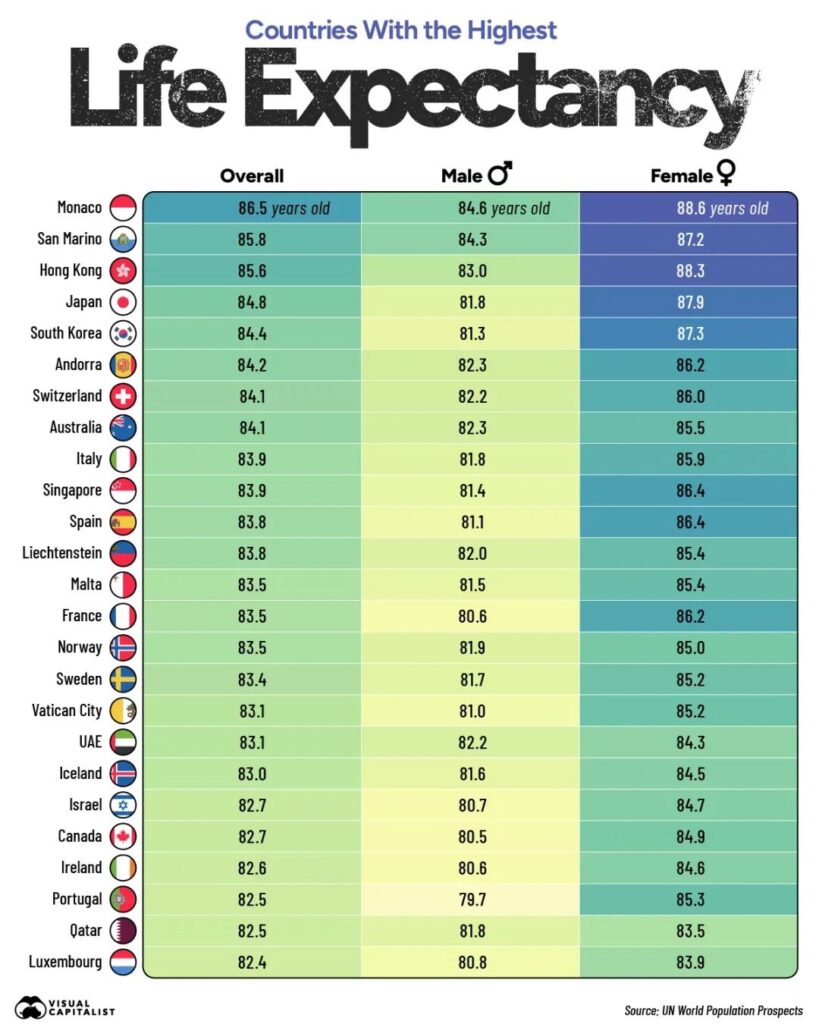
Monaco tops the latest United Nations projection with life expectancy at birth of about 86.5 years in 2025. San Marino follows at 85.8 years and Hong Kong at 85.6.
Those numbers are impressive, but they need a little unpacking. Life expectancy is not a forecast of how long a particular person will live. It is a statistical estimate of the years a newborn would live if the mortality rates observed or projected for that period continued throughout life.
The projected top ten
| Rank | Country or area | Projected life expectancy at birth |
|---|---|---|
| 1 | Monaco | 86.5 years |
| 2 | San Marino | 85.8 years |
| 3 | Hong Kong | 85.6 years |
| 4 | Japan | 84.8 years |
| 5 | South Korea | 84.4 years |
| 6 | Saint Barthélemy | 84.4 years |
| 7 | French Polynesia | 84.2 years |
| 8 | Andorra | 84.2 years |
| 9 | Switzerland | 84.1 years |
| 10 | Australia | 84.1 years |
Medium-variant projections for 2025 from the UN World Population Prospects 2024 revision. Figures are rounded to one decimal place. The list includes countries and areas used in the UN dataset.
Why is the source still called “World Population Prospects 2024”?
Population datasets do not arrive with the punctuality of a morning newspaper. The UN released the 2024 revision in July 2024 and issued a limited interim update in January 2026. It also announced that the next full revision, originally planned for 2026, has been postponed until 11 July 2027.
That means the 2024 revision remains the appropriate UN source in 2026. Relabelling its projections as newly measured “2026 data” would make the article appear fresher while making it less accurate—a small triumph of marketing over arithmetic that we can happily avoid.
Why small, affluent places dominate
Several leaders are wealthy microstates or compact territories. They often combine high incomes, broad healthcare access, strong public services and relatively safe environments. Their small populations can also make rankings more sensitive to migration, data revisions and a comparatively small number of deaths.
East Asia also performs strongly. Japan, South Korea and Hong Kong have long life expectancy despite differing health systems and lifestyles. Australia and Switzerland show that larger high-income countries can also rank near the top.
It is tempting to credit a single national habit—olive oil, green tea, walking or an admirably restrained relationship with dessert. In reality, longevity reflects decades of interacting factors: maternal and child health, vaccination, education, income, housing, pollution, road safety, tobacco use, diet, medical care and the distribution of those benefits across society.
Women live longer almost everywhere
Women have higher life expectancy than men in virtually every country and area in the dataset. Biology plays a role, but so do smoking and alcohol patterns, occupational hazards, road injuries, violence and differences in when people seek medical care.
The size of the gap varies substantially. That matters because a national average can conceal very different retirement, caregiving and health-planning realities for men and women.
Living longer is not the same as living well
Life expectancy measures years of life, not years free from disability or illness. Healthy life expectancy tries to estimate how many years people can expect to live in good health. The difference between the two measures represents years potentially lived with disease, disability or reduced independence.
For individuals and governments, that gap can be more useful than a longevity league table. Adding years is valuable; adding years with mobility, purpose, social connection and manageable health is better.
What these rankings can—and cannot—tell you
- They can compare broad mortality conditions across countries.
- They can reveal inequalities and help governments plan health and aged-care services.
- They cannot predict an individual lifespan.
- They do not prove that one diet, product or cultural habit causes longevity.
- Rankings from different publishers may disagree because they use different years, include or exclude territories, or mix observed data with projections.
The most useful lesson is not that everyone should move to Monaco—its property prices may shorten life through shock alone. It is that long lives tend to flourish where good healthcare, education, safety and social conditions are widely available.
Sources and further reading
World Bank: Life expectancy at birth indicator
United Nations: World Population Prospects 2024
United Nations: January 2026 interim update and next-release notice